
For cameras already installed, the federal rules, as they stand on November 16, 2026, reach a business through a federal contract or through federal grant or loan money.
Federal Contract
A federal agency may not contract with a company that uses covered equipment "as a substantial or essential component of any system, or as critical technology as part of any system," according to section 889(a)(1) of Public Law 115-232. Since August 13, 2020, FAR 4.2102(a)(2) applies that prohibition to your use anywhere in your business, "regardless of whether that use is in performance of work under a Federal contract."
We recommend listing every Hikvision or Dahua camera and recorder on your network before you plan the replacement.
Federal Grant or Loan Money
"Recipients and subrecipients are prohibited from obligating or expending loan or grant funds" to procure or obtain covered equipment, according to 2 CFR 200.216(a).
We recommend confirming the maker of every camera and recorder in a quote before grant money pays for it. Applying for a Nonprofit Security Grant? The same rule limits what the award can buy, so check which items it can pay for before you apply.
No Federal Contract or Federal Money
None of these federal rules prohibits a business with no federal contract and no federal money from keeping or using cameras already installed. A customer contract or an auditor may still ask for them to go, so ask what the contract or the audit requires before you decide. In most cases we can integrate your existing cameras, so we can monitor them while you decide whether to keep or replace them.
None of these federal rules, as they stand on November 16, 2026, makes it illegal for a business with no federal contract and no federal money to keep or use its installed cameras. Under FCC 25-71, the FCC can limit earlier authorizations to stop import and marketing "without prohibiting the continued use of such devices".
| Rule | Who it binds | What it does | What it does not do |
|---|---|---|---|
| Section 889 (Public Law 115-232), with FAR 4.2102 and 2 CFR 200.216 | Federal agencies, the companies they contract with, and recipients of federal grant or loan money | Bars agencies from buying covered equipment or contracting with a company that uses it as a substantial or essential component of any system, or as critical technology as part of any system. Bars grant and loan funds from paying for it. | Put any duty on a business with no federal contract, grant or loan about cameras it already has. |
| FCC Covered List (revision of November 6, 2026) | Hikvision and Dahua video surveillance and telecommunications equipment, including subsidiaries and affiliates | Lists that equipment "to the extent it is used for the purpose of public safety, security of government facilities, physical security surveillance of critical infrastructure, and other national security purposes", including services using it, since March 12, 2021. | Ban owning or using installed cameras. |
| FCC 22-84 and FCC 25-71 | The FCC’s equipment authorization program, import and marketing | Prohibits authorizing Hytera, Hikvision and Dahua equipment for those purposes. Lets the FCC limit earlier authorizations to stop continued importation and marketing. | Prohibit "the continued use of such devices". Order a recall or removal. |
Yes, for anyone these rules bind, such as a federal agency, a federal contractor or a recipient of federal grant or loan money. Section 889 of Public Law 115-232 names video surveillance and telecommunications equipment produced by Hikvision, Dahua and Hytera "or any subsidiary or affiliate of such entities", for public safety, security of government facilities, physical security surveillance of critical infrastructure and other national security purposes. What counts is who made the equipment, so check four things:
- Recorder: Under section 889, a recorder those makers produced counts, whatever brand is on the box.
- Cameras sold under another label: Section 889 names equipment by who produced it, not by the label on it, and the FCC Covered List says its listings "should be read to include the subsidiaries and affiliates of such entities".
- Parts inside new devices: Since October 13, 2026, FCC 26-50 bars authorizing devices that carry Covered List makers’ logic-bearing hardware components, where the device would be prohibited had that maker produced all of it. The FCC says it applies to new authorization applications and "does not affect previously authorized equipment".
- Monitoring services: Section 889 also covers "Telecommunications or video surveillance services provided by such entities or using such equipment", so having those cameras monitored is no fix for a contractor or grantee.
Before you buy NDAA-compliant security cameras, look up the brand or label of both the cameras and the recorder in our banned camera checker.
FAR 52.204-25 sets two deadlines when, during contract performance, you identify covered equipment or services, such as Hikvision or Dahua cameras, used as a substantial or essential component of any system or as critical technology as part of any system, or when a subcontractor at any tier or any other source tells you about it:
- Report: Within one business day, report it to the Contracting Officer, unless your contract sets another reporting procedure. For the Department of Defense, report to https://dibnet.dod.mil.
- Mitigation: Within 10 business days of that report, send any further available information on mitigation actions taken or recommended.
Separately, the clause goes into all your subcontracts and other contractual instruments. Its deadlines are for reporting and for describing mitigation. It sets no deadline for replacing the equipment.
IT staff and IT providers who have been through it describe replacement as forced on them rather than chosen. The push came from customer contracts that bar buying more Hikvision equipment, an auditor asking whether they were NDAA cameras, a federal customer under Section 889, and a warehouse that may lease to a federal agency. IT providers say their clients had to remove the cameras for 889 compliance, and one staffer inherited a building that had them and had to remove them all.
Cost held others back. IT providers say some clients cannot afford the replacement at this time. One IT provider described what happens next:
"When we take on clients who already have them, we inform them, show them the FCC order, and recommend replacing them. They rarely do, so we make them sign a waiver."
A private school that takes no federal money keeps using them.
School IT staff say grant money decided it: their districts paid for replacements with relief funds and safety grants and replaced the cameras one building at a time.
No Federal Contract or Grant Money
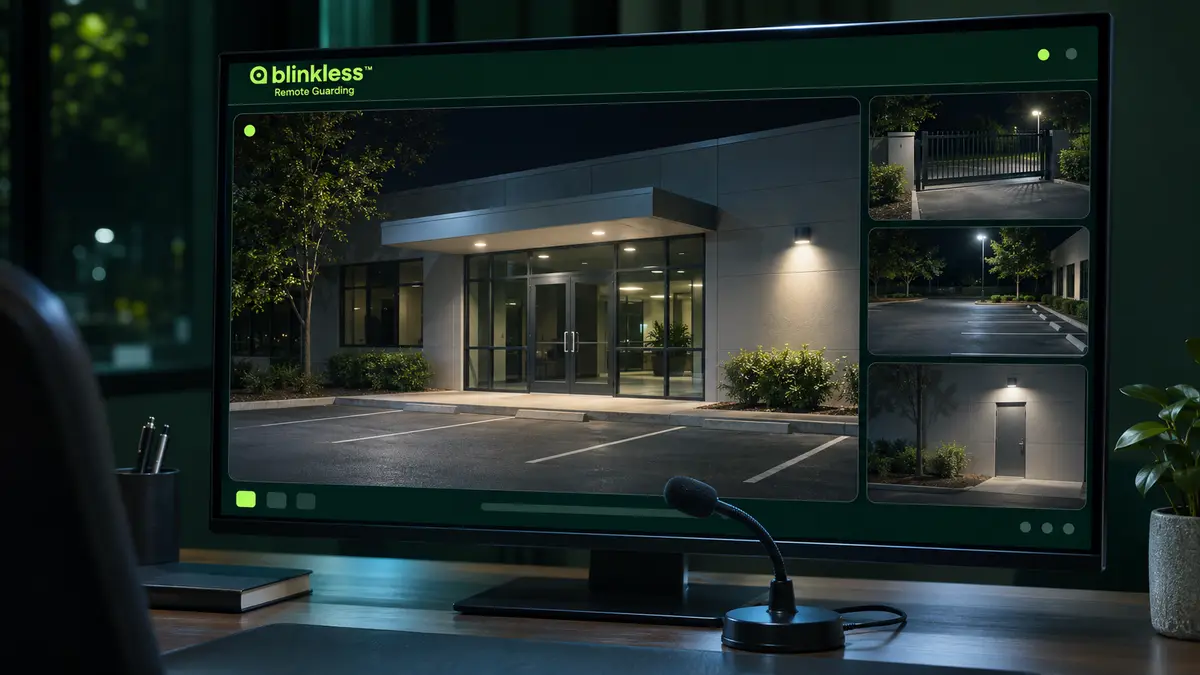
If your business holds no federal contract and spends no federal grant or loan money, you can keep your cameras working while you plan. We work with about 98% of camera systems, Hikvision and Dahua included, so we can monitor your existing cameras live during the hours you choose.
When a potential threat is detected, a trained Blinkless agent is alerted immediately and reviews the live feed. The agent warns intruders off the site over your speakers with a live voice-down, and we notify authorities when required. You receive instant alerts and comprehensive reporting through the Blinkless platform. See how remote video monitoring works on the cameras you already have.
Federal Contract or Grant Money
With a federal contract, monitoring the old cameras is not the fix, because section 889 of Public Law 115-232 also covers "video surveillance services ... using such equipment." With federal grant or loan money, 2 CFR 200.216(a) bars spending those funds on covered equipment or services. We install new cameras, swapping out the existing system, and we work with NDAA-compliant camera systems. Once the new cameras are in, we monitor them the same way. Before you order replacements, place them on a satellite view of your property in our camera planner.
Every rule on this page comes from its official text, so you can check the wording yourself; each was accessed on November 16, 2026. This is general information, not legal advice.
- Public Law 115-232, section 889 (govinfo.gov), accessed November 16, 2026
- 2 CFR 200.216 (eCFR), accessed November 16, 2026
- FAR 4.2102 (acquisition.gov), accessed November 16, 2026
- FAR 52.204-25 (acquisition.gov), accessed November 16, 2026
- FCC Covered List (fcc.gov), revision of November 6, 2026, accessed November 16, 2026
- FCC 22-84, 88 FR 7592 (Federal Register), published February 6, 2023, accessed November 16, 2026
- FCC 25-71, 90 FR 53227 (Federal Register), effective December 26, 2025, accessed November 16, 2026
- FCC 26-50, 91 FR 57798 (Federal Register), effective October 13, 2026, accessed November 16, 2026
The IT staff and IT providers quoted on this page are identified by role only.
You get a written security plan for your property, with no site visit needed, in three steps:
- Tell us about your property: Fill out the form, including whether you hold a federal contract or federal grant money, and a Blinkless security specialist will be in touch shortly.
- We assess it remotely: We review your site from satellite imagery and your existing cameras.
- You get your written plan: It sets out what needs monitoring, during which hours, how intruders and break-in attempts would be handled, and who gets alerted.
The plan is yours to keep, whether you hire Blinkless or not.